Grandma's Credenza Is Having a Moment — And You Can Rent It
Kira moved into her Bushwick apartment with a single duffel bag and a very specific aesthetic vision. No flat-pack. No Allen wrenches. No furniture that would fall apart in eighteen months and end up in a landfill. What she wanted was a 1970s velvet sectional, a brutalist coffee table, and a set of mismatched ceramic lamps that looked like they'd been inherited from someone with excellent taste.
What she didn't want was to own any of it permanently.
"I'm 27," she says. "I don't know where I'm going to be in two years. Why would I buy a couch?"
So she rented one. A genuine 1973 Milo Baughman sectional in burnt orange, sourced from a curated vintage rental service based in Brooklyn. Monthly fee. White-glove delivery. Return it whenever. Keep it forever if you fall in love.
The End of the IKEA Default
For a solid three decades, the script for furnishing your first real apartment was basically written for you. Head to IKEA, spend a Saturday in existential despair, assemble a KALLAX shelf, call it done. The furniture was cheap, it was fine, and it was designed to be disposable — which most of us eventually made it.
But something has shifted, and it's not just the aesthetics (though it's definitely also the aesthetics). A generation that grew up watching fast fashion get dismantled by sustainability critics is applying the same framework to furniture. The fast-furniture model — buy cheap, replace often, never think about where it ends up — is starting to feel as uncomfortable as a $12 polyester dress.
Enter the secondhand luxury rental market. A loose but growing ecosystem of peer-to-peer platforms, designer-curated rental services, and vintage dealers who've added rental tiers to their business models. The pitch isn't just environmental, though that's part of it. It's about access, flexibility, and — crucially — the kind of authentic, storied aesthetic that no amount of "distressed" finish at a big-box store can fake.
Who's Actually Doing This
The market is still fragmented, which is part of its charm. On one end, you have platforms like Feather (which leans more contemporary) and a growing number of regional services that specialize in genuine vintage pieces. On the other, you have individual dealers and estate sale professionals who've started offering rental agreements to younger clients who want the piece but not the permanence.
Then there's the peer-to-peer layer — people renting out furniture they've accumulated, the way Airbnb opened up real estate. A mid-century credenza sitting in someone's storage unit in Pasadena can now generate income while waiting for a buyer. Or never finding one, because the renter just keeps renewing.
Designers are paying attention. A handful of interior designers in major cities have built entire service models around what they're calling "impermanence-forward" interiors — spaces that are explicitly designed to evolve, with rental vintage pieces as the backbone. The aesthetic is intentional rather than accidental, layered rather than matched, and it photographs extraordinarily well, which is not irrelevant in 2024.
"My clients don't want a finished room," says one Los Angeles-based designer who works primarily with renters. "They want a room that feels like it has a history. Vintage rental gives you that without the commitment, and honestly, without the price tag of actually buying the good stuff."
The Ownership Question
Here's where it gets philosophically interesting. The rental economy has always had critics — the argument that renting is just paying forever for something you'll never own, that ownership builds wealth, that your grandmother's credenza was valuable because it was hers. These aren't wrong arguments.
But younger Americans, many of whom are locked out of homeownership and deeply skeptical of accumulating stuff they'll have to move or store or eventually throw away, are reframing the question. Ownership isn't the goal. Experience is the goal. And a beautiful piece of furniture you live with for two years and return in good condition might be a better experience than a particle-board dresser you own forever.
There's also something to be said for the circular economy logic. A well-made vintage piece — a solid walnut dining table, a properly constructed Eames-era lounge chair — doesn't degrade the way fast furniture does. It gets rented, returned, cleaned, rented again. It stays out of the landfill. It keeps circulating through homes that appreciate it. The object has a life that extends far beyond any single owner.
The Authenticity Premium
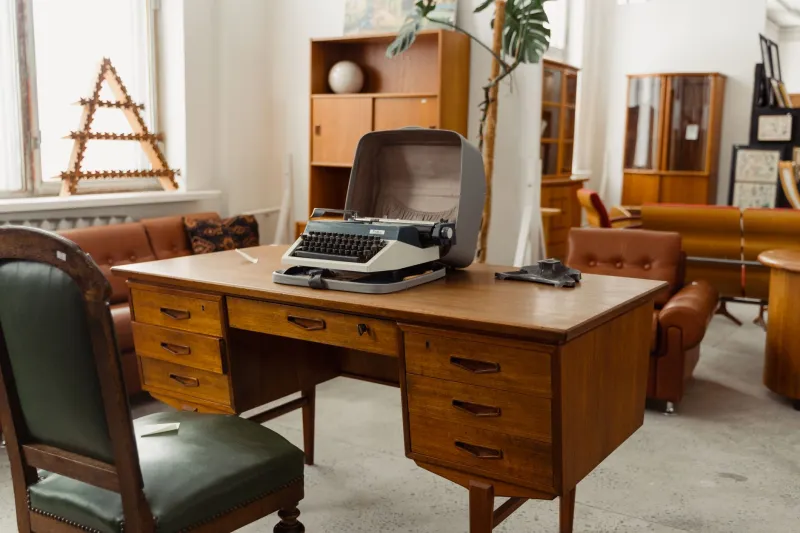
What's driving this more than sustainability, more than economics, might simply be the hunger for realness. In a world of algorithmically generated aesthetics and mass-produced "vintage-inspired" everything, an actual 1960s Scandinavian teak sideboard carries weight that no reproduction can match. It was made somewhere, by someone, for someone. It has a material history that you can feel in the grain.
Renting that sideboard rather than buying a fake one isn't a compromise. For a lot of people, it's a values statement — about what they want to live with, what they want to support, and what kind of relationship they want to have with their stuff.
Kira's Milo Baughman sectional, for what it's worth, is still in her apartment. She's renewed twice. She's considering buying it outright.
"I didn't think I'd get attached," she says. "But it turns out living with something beautiful for long enough makes you want to keep it. Which I guess is the whole point."
Maybe the rental model isn't killing ownership after all. Maybe it's just making ownership mean something again.