Spinning Against the Algorithm: Why Buying Vinyl Is a Revolutionary Act
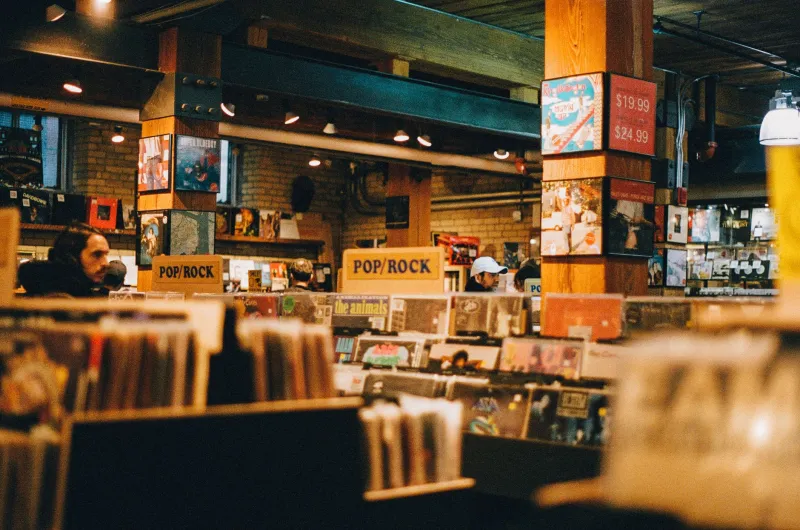
Walk into Permanent Records on North Milwaukee Avenue in Chicago on a Saturday afternoon and you'll find something that Spotify's product team probably can't fully quantify: people just hanging out. Flipping through records. Arguing about whether the original pressing of a Stevie Wonder album sounds better than the reissue. Asking the person next to them what they're holding. It's chaotic and slow and completely, stubbornly human.
That's exactly the point.
The vinyl revival has been written off as nostalgia tourism for years — a millennial affectation, a hipster quirk, a Gen Z aesthetic phase driven by TikTok aesthetics and Polaroid cameras. But spend any real time inside the independent record store ecosystem and you start to understand that something more deliberate is happening. Vinyl isn't just a format. For a lot of people, it's a position.
Follow the Money (Away from the Algorithm)
Streaming platforms generated over $17 billion in revenue in the US in 2023. Artists, on average, receive a fraction of a cent per stream. The math is brutal, and most music fans know it by now — even if they haven't fully changed their habits. But vinyl buyers? They've made a choice.
"Every time someone buys a record directly from me, or from the artist's table at a show, that money goes somewhere real," says Marcus Tello, who owns Dusty Groove in Chicago's Wicker Park neighborhood. "It goes to the pressing plant, to the artist, to my staff. It doesn't disappear into a server farm in Ireland."
Tello has watched his customer base shift noticeably over the last five years. Younger buyers — people in their early twenties — now make up a significant portion of his weekend foot traffic. And they're not just buying classic rock for their parents' turntables. They're hunting for local artists, small-label releases, anything that feels like it exists outside the algorithmic food chain.
Record Store Day, the annual April event that draws lines around the block at independent shops across the country, has become something of a cultural referendum. In 2024, independent record stores in the US reported over $35 million in sales on that single day alone. That's not nostalgia. That's an economic statement.
Musicians Are Making the Choice Too
It's not just collectors and shop owners who are leaning into the format with intention. A growing number of artists — particularly those working in indie, folk, and experimental spaces — are deliberately choosing vinyl as their primary release vehicle, even when the economics don't obviously favor it.
Nadia Rae, a Chicago-based singer-songwriter who records under the name Pale Harbor, pressed her last EP on vinyl through a community-funded campaign that sold out before the records even arrived at the pressing plant. She could have dropped it on streaming services and called it a day. She did eventually, but the vinyl came first.
"I wanted the first experience of this music to be physical," she explains. "I wanted someone to hold it, read the liner notes, look at the artwork. Streaming flattens everything. It turns an album into content. I didn't make content — I made a record."
That distinction — content versus record — is showing up everywhere in conversations with musicians right now. The word "content" has become almost a slur in certain creative circles, a shorthand for the way platforms have reduced art to units of engagement. Vinyl resists that reduction almost by design. You can't shuffle a record. You can't skip to the chorus with a tap. You have to commit.
Community as Infrastructure
What's easy to miss in the vinyl conversation is how much of it is actually about place. Independent record stores function as something closer to community centers than retail outlets. They host listening parties, in-store performances, zine fairs, political fundraisers. They're one of the last commercial spaces where you can show up alone and reliably leave having talked to a stranger about something that matters to you.
In cities like Nashville, Portland, and Philadelphia, record stores have become anchor institutions for neighborhood identity in ways that chain retail never could. When a beloved shop closes, the grief is real and public. When a new one opens, it's an event.
"We're not just selling records," says Tello. "We're maintaining a space where people can disagree about music in person. That sounds small, but I think it's actually huge right now."
In an era when most cultural consumption happens alone, in the dark, mediated by an algorithm designed to keep you from ever encountering anything genuinely surprising, that friction — the argument, the accidental discovery, the weird recommendation from a stranger — starts to feel radical.
The Bigger Picture
None of this is to say that streaming is going away, or that vinyl will ever reclaim its mid-century dominance. That's not really the argument. The argument is that choosing to buy a record — from an independent store, directly from an artist, at a show — is a way of voting with your wallet for a different kind of music economy. One that isn't optimized for engagement. One that doesn't flatten everything into a playlist.
And increasingly, the people making that choice know exactly what they're doing. They're not being romantic about the past. They're being deliberate about the future.
The needle drops. The room fills with sound. Nobody's tracking your listening data. For a few minutes, the algorithm doesn't know you exist.
That's not nothing. That might actually be everything.