Two Drinks, One Microphone: Why Nobody Lies at Karaoke
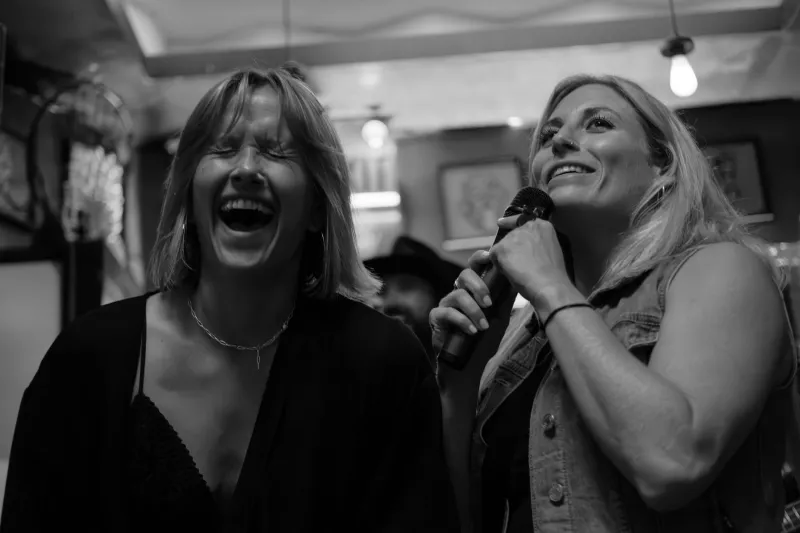
There's a moment that happens at every karaoke bar in America, usually around 11 p.m., when somebody who has been sitting quietly in the corner all night suddenly stands up, grabs the songbook, and mutters something like 'play Total Eclipse of the Heart.' Nobody flinches. Nobody films. The room simply makes space.
If you've been in that moment, you already know something that the rest of our carefully managed social lives have forgotten: karaoke is the rare ritual where vulnerability isn't just tolerated — it's the whole point.
The Rules of the Room
Spend enough nights around karaoke regulars and you start noticing the unwritten constitution. You don't boo. You don't skip someone's song, no matter how rough the high notes get. You clap when the song ends, always, because the performance was never the point. The showing up was.
'It's the only bar in town where a 62-year-old steelworker and a 22-year-old nursing student are rooting for each other,' says Dez, a karaoke jockey who runs the Wednesday night slot at a dive outside Pittsburgh. 'I've watched people who've lived on the same block for a decade meet for the first time over a duet.'
That's not an accident of the format. It's the design. Karaoke strips away everything we usually hide behind. There's no caption to polish, no filter, no take-backs. You pick a song, you stand up, and for three minutes and forty seconds you are exactly as good — or as gloriously bad — as you actually are.
The Private Room Revolution
Not everyone wants the open-mic gauntlet, and the market has noticed. Across metro Atlanta, Korean noraebang rooms — private karaoke suites stocked with tambourines, popcorn machines, and touchscreens loaded with tens of thousands of tracks — have become the default birthday format for twenty-somethings of every background.
The appeal is obvious once you've been in one. With just your friends in the room, the stakes collapse. My usually reserved coworker performed a full choreographed rendition of a K-pop song I won't name here, and something shifted between us afterward. You cannot unsee a person that way. You can only like them more.
Gen Z, a generation that reportedly struggles to make phone calls, has embraced both formats with an enthusiasm that surprises their elders. The explanation, according to regulars, is almost paradoxical: a generation raised on performance has developed a hunger for the non-performed.
'Online, you're always the editor of yourself,' says Mina, a college senior who hosts a monthly noraebang night. 'In here, you're just a person holding a microphone badly. It's a relief.'
What the Algorithm Can't Sell You
Social media promised connection and delivered audience. Karaoke promises nothing and delivers communion. There's no metric to optimize. Your rendition of 'Livin' on a Prayer' doesn't trend, doesn't get engagement, doesn't build a personal brand. It just exists, briefly, among people who chose to be in the room.
Bartenders notice the difference in the crowd. 'Normal bar nights, everyone's scanning the room, half-watching a game,' one longtime regular told me. 'Karaoke night, people are facing each other. It's the only night I don't have to work to keep the energy up.'
There's something quietly radical in that. In an era when nearly every shared space has been monetized, optimized, or turned into content, the karaoke bar remains stubbornly inefficient. The songs are too long. The equipment is held together with duct tape and hope. The KJ takes requests on paper slips. And yet it's thriving — not despite the jank, but because of it.
The Last Equal Stage
Call it the last democratic institution, half-jokingly. But the framing holds up better than it should. At the mic, status dissolves. The surgeon butchers Fleetwood Mac. The dishwasher delivers a note-perfect Whitney Houston and brings the house down. Everyone waits their turn. Everyone gets one.
Dez, the Pittsburgh KJ, puts it more plainly: 'People ask me why I do this for beer money. Man, I get to watch a room full of strangers decide to be kind to each other for four hours. Where else are you getting that?'
Where else, indeed. So the next time you're standing at the edge of a karaoke bar, songbook in hand, heart hammering — go up. The room is not judging you. The room was you, thirty minutes ago, waiting for someone else to be brave first.
Somebody has to break the seal. It might as well be you.