More Than Books: How Indie Bookstores Became the Living Rooms America Forgot It Needed
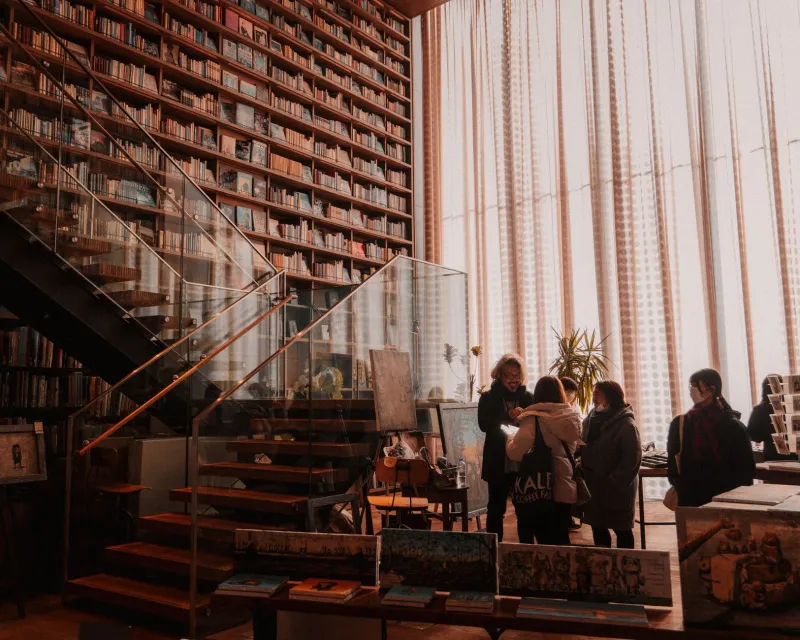
Walk into Literati Bookstore in Ann Arbor on a Thursday evening and you might catch a debut novelist reading to a crowd of forty people nursing natural wine. Or a local printmaker pinning work to a temporary gallery wall between the travel section and the kids' corner. Or nothing at all — just people sitting, reading, not buying anything, not being asked to leave.
That last part is kind of the whole point.
The Third Place Problem
Urban sociologist Ray Oldenburg coined the term "third place" back in 1989 — the idea that healthy communities need spaces that are neither home nor work, where people can gather without agenda or transaction. He was talking about barbershops, diners, public parks. What he probably wasn't picturing was a carefully curated indie bookstore with a pour-over bar and a rotating residency program for local poets. But here we are.
Across the country, independent booksellers are making a quiet but radical architectural choice: expanding their square footage not into more shelves, but into more room. Seating areas that don't feel like afterthoughts. Small stages. Wine licenses. Kitchens. Event spaces that double as galleries on weekends and recording studios on Tuesday afternoons.
The move isn't about revenue diversification, at least not primarily. Ask the owners and they'll tell you something more interesting: they're trying to solve a loneliness problem.
"People aren't just coming in to pick up a book they already ordered online," says the co-owner of a Chicago shop that opened a wine bar in its back room two years ago. "They're coming in because they want to be somewhere that feels like it was made for them. The book is almost secondary to that feeling."
What Starbucks Got Wrong (And What Bookstores Are Getting Right)
For a while, coffee chains promised to be that third place. The marketing was explicit about it — Starbucks literally built its brand identity around the concept. But somewhere between the loyalty app, the drive-through window, and the algorithmic playlist piped through every location in America, the actual place part got hollowed out. You can't linger somewhere that's optimizing you toward the exit.
Independent bookstores, operating without shareholders and often on razor-thin margins, have accidentally stumbled into the gap that corporate hospitality left behind. They're not trying to scale. They're trying to stay, which turns out to be a completely different design philosophy.
At Loyalty Bookstore in Washington, D.C., the event calendar reads less like a promotional schedule and more like a neighborhood bulletin board — author talks, yes, but also community conversations, writing workshops for teens, and open mics that have nothing to do with whatever's on the new releases table. The bookstore as programming venue. The bookstore as civic institution.
The Café Is a Trojan Horse
Here's what the café actually does: it buys time. Not in a cynical way, but in a deeply practical one. When someone can sit down with a latte and flip through three different novels before committing to one, they're not being inefficient — they're doing exactly what a bookstore should want them to do. They're becoming readers in real time, in public, in a way that an Amazon cart never allows.
The event space does something similar, but for community. A poetry reading fills a room with people who might not have known the bookstore existed. A local artist's opening brings in a crowd that discovers the fiction section on their way to the bathroom. A zine fair turns a Saturday afternoon into a cultural moment that people talk about for weeks.
Shops like The Ripped Bodice in Burbank — a romance-only bookstore that has become a legitimate institution — or Semicolon in Chicago, which hosts everything from author events to mental health conversations, aren't running cafés because coffee is profitable. They're running cafés because coffee gives people a reason to stay, and staying is where culture actually happens.
The Real Estate Math Nobody Talks About
There's a harder, more structural truth underneath all of this. Independent bookstores have been in financial crisis for decades — not because people stopped reading, but because the economics of selling physical books in expensive retail spaces are genuinely brutal. Amazon, e-books, and the consolidation of publishing have all taken their toll.
Adding a café or event space isn't just a cultural statement. It's a survival strategy. And the fact that survival looks like more community rather than less is, honestly, kind of beautiful.
Event tickets, venue rentals for private gatherings, membership programs that give regulars access to exclusive readings — these micro-revenue streams don't replace book sales, but they create enough financial cushion to keep the lights on. More importantly, they create loyalty that no loyalty app can manufacture.
"The people who come to our events buy books," one Brooklyn bookseller told us. "Not always that night, not always that week. But they come back. They bring their friends. They feel like they own a piece of this place, even though they don't. That's worth more than any margin calculation."
What It Means for How We Consume Culture
There's a broader shift happening here that goes beyond bookselling. Americans are increasingly tired of consuming culture alone, in the dark, through a screen that knows exactly what they want before they do. The appetite for unmediated cultural experience — messy, unpredictable, human — is enormous and largely unmet by existing institutions.
Museums are trying. Theaters are trying. But bookstores, with their low barrier to entry, their neighborhood scale, and their fundamental commitment to the idea that stories matter, might be the most natural home for this kind of gathering.
The bookstore that's also a café, a gallery, a stage, and a living room isn't a gimmick. It's an answer to a question a lot of Americans are quietly asking: Where do I go to be part of something?
Turns out, it might be between the poetry section and the cold brew tap.