Touching Grass, But Make It Art: Why Young Americans Are Choosing the Slow and the Handmade
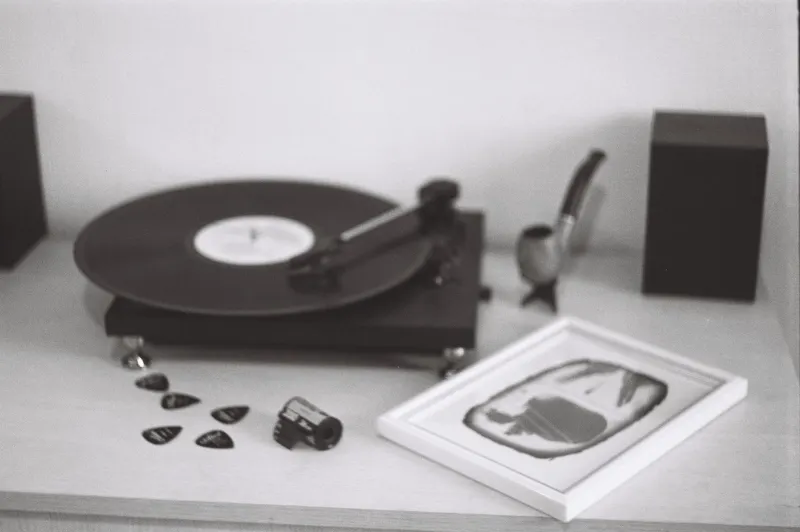
Let's start with a number that feels impossible: Kodak's film sales have grown every year since 2012. In an era when the average American takes more photos in a week than their grandparents took in a lifetime — all of them instantly shareable, infinitely reproducible, essentially free — people are choosing to spend money on a medium that gives you 36 exposures, costs real dollars to develop, and might come back from the lab looking like garbage if you accidentally exposed it wrong.
They're doing it anyway. And not just photography.
Vinyl record sales have outpaced CD sales for multiple consecutive years. Pottery studios across the country have waitlists months long. Letterpress printing, a technology that was nearly extinct a decade ago, now sustains hundreds of small studios catering almost exclusively to millennials and Gen Z customers. Sourdough had its pandemic moment, but the home fermentation and bread-baking communities it created didn't dissolve when restaurants reopened — they kept going, kept growing, kept posting their imperfect loaves with obvious pride.
Something is happening here. The question is what.
The Obvious Explanation (And Why It's Incomplete)
Nostalgia is the easy answer, and it's not entirely wrong. There's clearly something appealing about the aesthetics of analog — the grain of film photography, the warmth of vinyl playback, the tactile imperfection of hand-thrown pottery. These things carry emotional associations with slower, perhaps simpler times, and in an era of relentless digital acceleration, that pull is real.
But nostalgia doesn't fully explain why a 23-year-old who grew up entirely digital is spending $800 on a film camera for a medium she has no personal memory of. She's not recreating something she lost. She's seeking something she never had — and that's a fundamentally different psychological operation.
"I didn't grow up with film," says Maya Chen, a graphic designer in Portland who shoots exclusively on a 1970s Pentax she found at an estate sale. "My nostalgia, if that's even the right word, is for a relationship with images that I've never actually had. I wanted to slow down and actually think about what I was photographing. Digital made it too easy to just spray and pray."
That phrase — "too easy" — comes up repeatedly in conversations with analog enthusiasts. And it points toward something more interesting than nostalgia.
The Friction Is the Point
Digital technology optimized relentlessly for ease. Fewer steps, faster results, lower barriers to entry. For most applications, this is straightforwardly good. But in creative practice, friction turns out to have value that optimization removes.
When you have 36 frames on a roll of film, you think differently about each shot. When a pot takes three hours to throw and another week to fire, you're invested in it in a way that a mass-produced object from Target simply doesn't generate. When you hand-set type for a letterpress print, you understand typography in your body — in your hands and your back — in a way that moving fonts around in InDesign simply doesn't replicate.
This isn't anti-technology sentiment. Most of the people leading the analog revival are also heavy technology users. They're not rejecting digital; they're supplementing it with practices that offer something digital can't — resistance, slowness, and the particular satisfaction of making something that couldn't have been made any faster.
"There's a real difference between a skill and a setting," says James Okafor, who teaches bookbinding workshops in Chicago. "When I learned bookbinding, I had to actually develop the skill. My hands had to learn something. That's a different relationship to making than clicking through a tutorial and applying a filter."
Sustainability, Scarcity, and the Ethics of Objects
There's another thread running through the analog revival that gets less attention: a genuine environmental and ethical consciousness about how objects are made and consumed.
Fast fashion's environmental cost is now widely understood among younger Americans, and that consciousness is spreading to other categories of consumption. The appeal of a well-made, repairable, potentially heirloom-quality object — a good turntable, a hand-thrown mug, a leather-bound journal — is partly aesthetic and partly ethical. These are things that last. They don't end up in a landfill after six months.
This connects to the broader repair culture movement that's been building quietly alongside the analog revival. The same demographic that's buying film cameras is also learning to mend clothes, fix bicycles, and repair electronics. The through-line is a rejection of disposability — a desire for a different relationship with objects than the one consumer capitalism has been selling.
"I think a lot of us are realizing that convenience has a cost," says Priya Mehta, who left a tech marketing job to open a natural dye textile studio in Asheville. "Every time something is made easier, something else is lost. I'm not saying that's always a bad trade. But I wanted to make some things harder again, consciously, and see what came back."
What This Reveals About How We Want to Create
There's a tension at the heart of contemporary creative culture that the analog revival makes visible. We live in an era of unprecedented creative tools — anyone with a smartphone has access to recording, photography, video, and publishing capabilities that would have seemed miraculous twenty years ago. And yet there's a widespread sense of creative dissatisfaction, a feeling that something essential is missing from the frictionless creative process.
Part of what's missing might be embodiment. Digital creation happens in a visual and auditory register but largely excludes the body's other capacities. You don't smell digital photography. You don't feel the resistance of clay against your hands when you're designing in Figma. The analog revival is, among other things, a return to full-body making — to creative practices that engage the whole sensory apparatus.
It's also, perhaps, a response to the anxiety of infinite possibility. When everything is possible and nothing costs anything, creative choices become paradoxically harder. Constraints — the 36-frame roll, the fixed typefaces in a letterpress drawer, the properties of a particular clay body — force decisions and generate the creative tension from which interesting work emerges.
Authenticity in the Age of Everything Fake
Finally, there's the question of authenticity — a word that's been so overused it's nearly meaningless, but that still points toward something real. In an environment saturated with AI-generated imagery, algorithmically produced music, and content designed by engagement metrics rather than human intention, the handmade carries a particular charge.
A hand-thrown pot is the record of a specific body making a specific object on a specific day. A film photograph carries the light of a real moment, captured through a mechanical process that left no room for the post-processing adjustments that make digital photography so infinitely malleable. These aren't just aesthetic qualities. They're a form of evidence — proof that a human being was actually there, actually made something, actually tried.
In 2024, that proof feels more valuable than it used to. And that, maybe, is the most honest explanation for why young Americans are reaching past their screens toward the slow, the tactile, and the made-by-hand. Not because the digital world is bad. But because the analog world reminds them that they have bodies, and that those bodies are capable of making things that matter.